
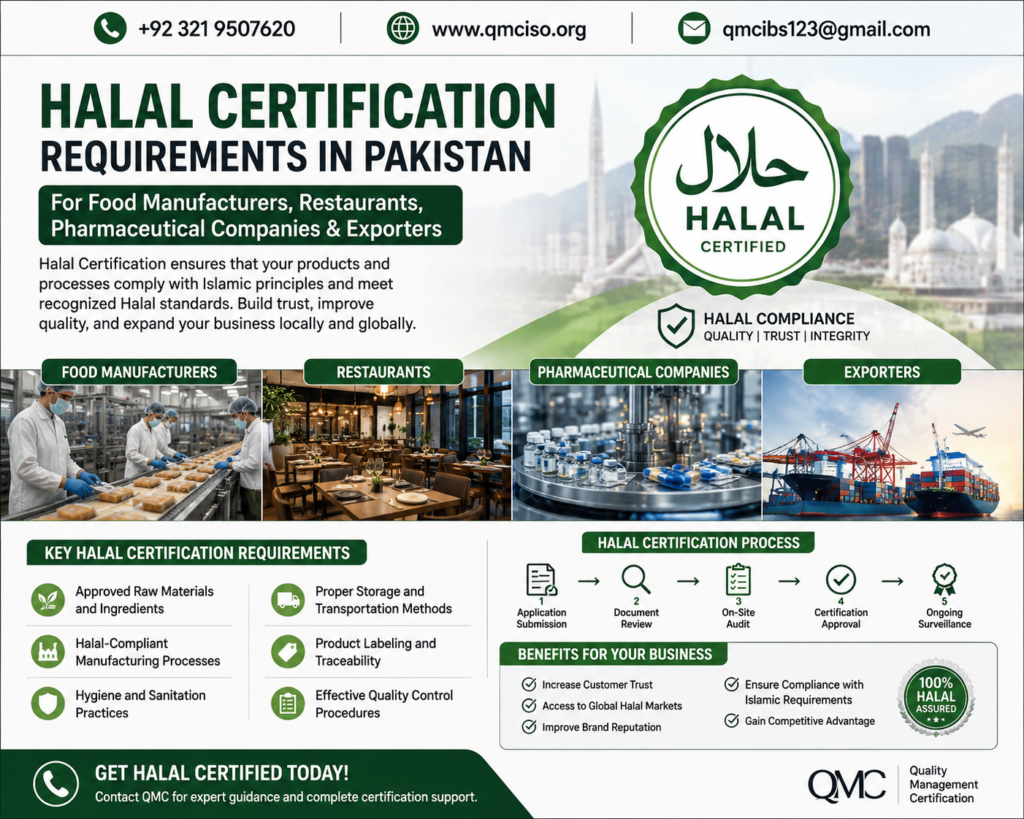
Halal Certification is becoming increasingly important for businesses in Pakistan. It confirms that products, ingredients, and manufacturing processes comply with Islamic principles and recognized Halal standards. As a result, certified businesses can build customer trust, improve brand reputation, and access local and international markets.
What is Halal Certification?
Halal Certification is an official approval that verifies products and services comply with Islamic dietary laws and Halal requirements.
It covers:
- Raw material verification to ensure compliance with Halal requirements
- Production process monitoring to maintain product integrity
- Hygiene and sanitation management throughout operations
- Proper storage and transportation controls to prevent contamination
- Product labeling and traceability for improved transparency
- Quality assurance measures to support consistent compliance
Who Needs Halal Certification in Pakistan?
Many industries can benefit from Halal Certification, including:
Food & Beverage Industry
- Food manufacturers
- Dairy producers
- Beverage companies
- Meat processing facilities
Restaurants & Catering Services
- Restaurants
- Fast-food chains
- Catering businesses
- Hotels and kitchens
Pharmaceutical & Healthcare Sector
- Pharmaceutical manufacturers
- Nutritional supplement producers
- Healthcare product suppliers
Cosmetics & Personal Care Industry
- Cosmetic manufacturers
- Skincare brands
- Personal care product companies
Key Requirements for Halal Certification
To obtain Halal Certification in Pakistan, businesses must meet the following requirements:
1. Use Halal-Compliant Ingredients
- All ingredients must come from approved Halal sources.
- Non-Halal materials must not be used in certified products.
2. Maintain Proper Documentation
Organizations should keep records of:
- Supplier approvals
- Ingredient specifications
- Production procedures
- Quality control activities
3. Implement Hygiene Controls
Businesses must ensure:
- Clean production environments
- Proper sanitation procedures
- Safe handling practices
4. Prevent Cross-Contamination
Companies should:
- Separate Halal and non-Halal materials
- Use dedicated storage areas where required
- Follow approved handling procedures
5. Train Employees
Staff members should receive training on:
- Halal requirements
- Production procedures
- Hygiene practices
- Product handling controls
Benefits of Halal Certification
Organizations that achieve Halal Certification can enjoy several advantages:
✔ Increased Customer Confidence
Consumers prefer products that clearly demonstrate Halal compliance.
✔ Access to International Markets
Many countries require Halal Certification for imported products.
✔ Improved Brand Reputation
Certification shows a commitment to quality and compliance.
✔ Competitive Business Advantage
Certified companies often stand out from competitors in the marketplace.
✔ Higher Export Opportunities
Halal Certification can help businesses expand into global Muslim markets.
Steps to Obtain Halal Certification
The certification process generally includes the following steps:
Step 1: Submit Application
Provide company details, product information, and manufacturing data.
Step 2: Documentation Review
Experts review ingredients, suppliers, and operational procedures.
Step 3: Facility Inspection
Auditors visit the site to assess compliance with Halal requirements.
Step 4: Corrective Actions
Any identified issues must be resolved before approval.
Step 5: Certification Approval
After successful evaluation, the Halal Certificate is issued.
Step 6: Surveillance Audits
Periodic audits help maintain certification and ongoing compliance.
Why Choose QMC for Halal Certification?
QMC provides professional consultancy and certification support services across Pakistan. Our experienced team helps organizations understand requirements, prepare documentation, implement controls, and successfully achieve Halal Certification.
Our Services Include:
- Gap Analysis and readiness assessment
- Documentation development and review
- Audit preparation and support
- Compliance consulting and implementation guidance
- Certification assistance and coordination
- Post-certification support and maintenance
Related Certifications
Contact Information
📞 +92 321 9507620
Get Halal Certified Today
Ready to meet the Halal Certification Requirements in Pakistan?
Contact QMC today for expert guidance and complete certification support. Our team is ready to help your business achieve Halal compliance and expand into new markets.