
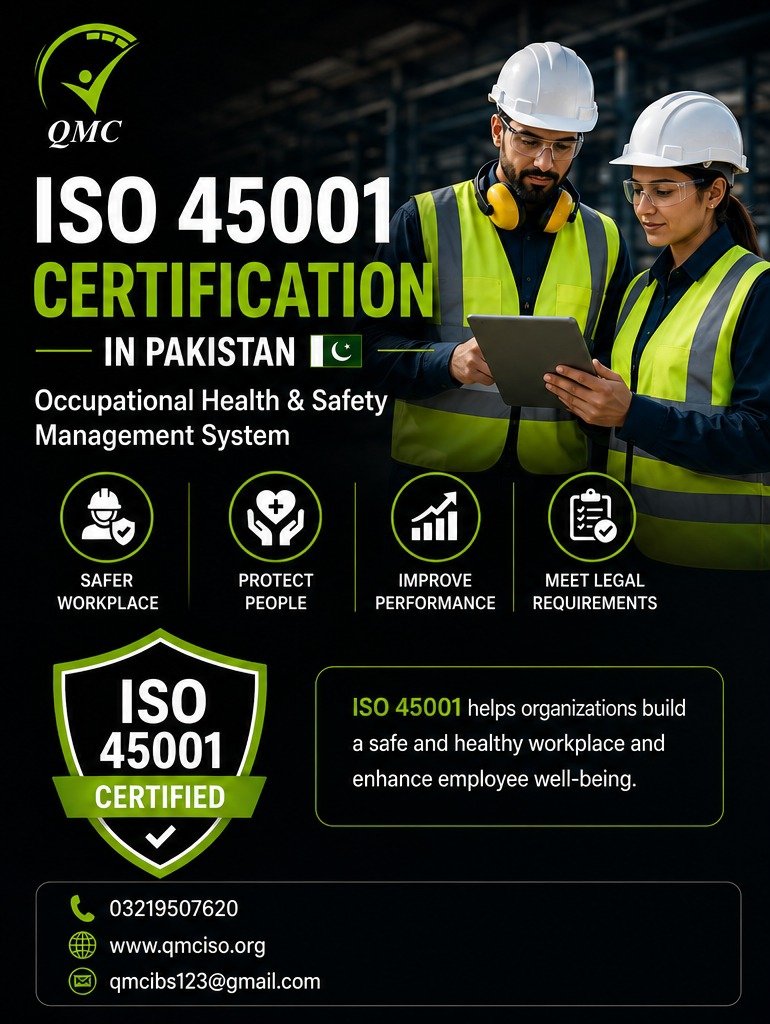
Every successful organization understands that its employees are its greatest asset. Therefore, maintaining a safe and healthy workplace should always be a top priority. ISO 45001 Certification in Pakistan provides organizations with an internationally recognized framework for managing occupational health and safety risks while improving workplace performance.
Whether your organization operates in manufacturing, construction, healthcare, logistics, engineering, education, food processing, or any other industry, implementing ISO 45001 demonstrates a strong commitment to employee safety and continual improvement. Moreover, it helps businesses comply with legal requirements, reduce workplace incidents, and strengthen customer confidence.
As industries continue to evolve, workplace hazards also become more complex. Consequently, organizations need a systematic approach to identify risks, prevent injuries, and promote a positive safety culture. ISO 45001 offers exactly that by providing practical guidelines that help businesses protect their workforce while improving operational efficiency.
Today, many public and private organizations across Pakistan are adopting ISO 45001 Certification in Pakistan because international clients, government projects, and multinational companies increasingly expect suppliers to follow globally recognized occupational health and safety standards. As a result, certified organizations gain a competitive advantage while building long-term trust with customers and stakeholders.
Understanding ISO 45001 Certification
ISO 45001 is the international standard for Occupational Health and Safety Management Systems (OHSMS), developed by the International Organization for Standardization (ISO). It was designed to help organizations create safer workplaces by reducing occupational risks and preventing work-related injuries and illnesses.
Unlike traditional safety programs that only react to incidents, ISO 45001 encourages organizations to identify hazards before accidents occur. Furthermore, it promotes proactive risk management, employee participation, leadership commitment, and continual improvement throughout the organization.
The standard follows the internationally accepted Plan-Do-Check-Act (PDCA) cycle, enabling businesses to improve their occupational health and safety performance continuously. Consequently, organizations not only reduce workplace accidents but also increase operational efficiency and employee satisfaction.
ISO 45001 can be implemented by organizations of every size, whether they employ ten people or ten thousand. In addition, it can be integrated with other ISO management systems such as ISO 9001 for Quality Management and ISO 14001 for Environmental Management, making it an excellent choice for businesses seeking comprehensive operational excellence.
Why ISO 45001 Certification Matters for Pakistani Businesses
Pakistan’s industrial sector continues to grow rapidly. Therefore, organizations face increasing responsibilities to ensure employee safety while complying with national occupational health and safety regulations.
Implementing ISO 45001 Certification in Pakistan helps organizations establish structured health and safety procedures that protect employees, visitors, contractors, and other interested parties.
Some of the key reasons businesses choose ISO 45001 include:
- Creating a healthier workplace
- Preventing workplace injuries and illnesses
- Identifying hazards before incidents occur
- Reducing operational downtime
- Improving employee engagement
- Meeting legal and regulatory obligations
- Increasing customer confidence
- Enhancing business reputation
- Supporting sustainable business growth
- Improving organizational resilience
Moreover, companies that maintain excellent safety records often experience lower insurance costs, reduced compensation claims, and fewer operational disruptions. Consequently, investing in workplace safety also contributes to financial stability.
Another important benefit is improved employee morale. When workers know their employer genuinely values their health and safety, they become more motivated, productive, and committed to organizational success.
Key Principles of ISO 45001
The effectiveness of ISO 45001 depends on several fundamental principles that guide organizations toward continuous improvement.
These principles include:
- Strong leadership commitment
- Active employee participation
- Risk-based thinking
- Hazard identification
- Legal compliance
- Continual improvement
- Performance evaluation
- Evidence-based decision-making
- Effective communication
- Operational control
Rather than focusing only on documentation, ISO 45001 emphasizes building a proactive safety culture where everyone contributes to workplace health and safety.
Organizations that successfully implement these principles usually experience fewer incidents, stronger teamwork, and improved operational performance.
Major Benefits of ISO 45001 Certification
Implementing ISO 45001 provides long-term advantages that extend beyond regulatory compliance.
Key benefits include:
- Improved Workplace Safety
Organizations can identify hazards early and implement preventive measures before accidents occur.
- Reduced Workplace Accidents
Effective risk management significantly lowers the number of injuries, illnesses, and near misses.
- Better Legal Compliance
Businesses remain aligned with applicable occupational health and safety laws and regulations.
- Higher Employee Confidence
Employees feel safer when working in an organization that prioritizes health and safety.
- Increased Productivity
Safe workplaces experience fewer interruptions, allowing employees to focus on delivering quality work.
- Improved Business Reputation
Certification demonstrates professionalism and responsibility, enhancing credibility among customers and stakeholders.
- Stronger Competitive Advantage
Many government projects, multinational organizations, and international buyers prefer certified suppliers.
- Lower Operational Costs
Reducing workplace incidents helps minimize medical expenses, insurance claims, equipment damage, and production delays.
- Continual Improvement
Regular internal audits, management reviews, and performance monitoring encourage organizations to improve continuously.
ISO 45001 Certification Requirements in Pakistan
Achieving ISO 45001 Certification in Pakistan requires organizations to establish, implement, maintain, and continually improve an Occupational Health and Safety Management System (OHSMS). Although the certification process may appear challenging at first, it becomes straightforward when organizations follow a structured implementation plan.
The standard focuses on preventing workplace injuries instead of simply responding to incidents after they occur. Therefore, organizations should identify hazards, evaluate risks, and implement appropriate control measures before problems arise.
The main requirements include:
- Understanding the organization’s internal and external context
- Identifying interested parties and their expectations
- Establishing an Occupational Health and Safety Policy
- Defining measurable health and safety objectives
- Identifying workplace hazards
- Conducting comprehensive risk assessments
- Evaluating opportunities for improvement
- Meeting legal and regulatory requirements
- Allocating resources for implementation
- Assigning responsibilities and authorities
- Providing employee awareness and competency training
- Ensuring effective internal communication
- Maintaining documented information
- Implementing operational controls
- Preparing emergency response procedures
- Monitoring and measuring performance
- Conducting internal audits
- Performing management reviews
- Taking corrective actions
- Driving continual improvement
Furthermore, organizations should regularly evaluate the effectiveness of their Occupational Health and Safety Management System to ensure continuous compliance and improvement.
The ISO 45001 Certification Process
Implementing ISO 45001 becomes much easier when businesses follow a systematic certification process. Each stage contributes to building a stronger Occupational Health and Safety Management System.
1. Initial Consultation
The certification journey begins with understanding your organization’s activities, workplace risks, business objectives, and compliance requirements.
2. Gap Analysis
Next, experienced consultants compare your existing management practices against ISO 45001 requirements. Consequently, they identify areas requiring improvement before implementation begins.
3. Documentation Development
Proper documentation forms the backbone of every management system.
Typical documentation includes:
- Occupational Health and Safety Policy
- Risk Assessment Register
- Hazard Identification Records
- Emergency Response Procedures
- Safe Work Instructions
- Objectives and KPIs
- Training Records
- Incident Reports
- Internal Audit Reports
- Management Review Records
Well-organized documentation also simplifies future audits and continual improvement activities.
4. System Implementation
After documentation is completed, organizations implement the management system across all departments.
During implementation, employees begin following standardized safety procedures while management monitors overall effectiveness.
5. Employee Awareness and Training
Employees play an essential role in ISO 45001 implementation.
Training generally covers:
- Workplace hazards
- Personal Protective Equipment (PPE)
- Emergency procedures
- Incident reporting
- Safe working practices
- Legal responsibilities
- Risk awareness
As a result, employees become more confident in identifying hazards and preventing accidents.
6. Internal Audit
Once implementation is complete, organizations perform an internal audit to verify compliance with ISO 45001 requirements.
Internal audits help identify weaknesses before the external certification audit takes place.
7. Management Review
Senior management reviews audit findings, safety performance, risks, objectives, and opportunities for improvement.
Consequently, leadership demonstrates its commitment to continual improvement.
8. Certification Audit
Finally, an accredited certification body evaluates the Occupational Health and Safety Management System.
If all requirements are successfully met, the organization receives ISO 45001 Certification in Pakistan.
Industries That Benefit from ISO 45001 Certification
ISO 45001 is designed for organizations of every size and sector. Regardless of the industry, every workplace contains potential hazards that require systematic management.
Organizations that commonly implement ISO 45001 include:
- Manufacturing Companies
- Construction Companies
- Pharmaceutical Manufacturers
- Food Processing Industries
- Hospitals and Healthcare Facilities
- Engineering Companies
- Textile Industries
- Chemical Manufacturers
- Oil and Gas Companies
- Warehouses
- Logistics Providers
- Transportation Companies
- Educational Institutions
- Government Organizations
- IT Companies
- Service Providers
Moreover, many international clients specifically prefer suppliers that maintain certified occupational health and safety management systems.
Common Workplace Hazards Addressed by ISO 45001
An effective Occupational Health and Safety Management System help organizations identify numerous workplace hazards before they become serious incidents.
Examples include:
- Slips, trips, and falls
- Fire hazards
- Electrical hazards
- Chemical exposure
- Heavy machinery risks
- Manual handling injuries
- Noise pollution
- Poor ergonomics
- Confined space hazards
- Working at heights
- Vehicle movement risks
- Biological hazards
- Fatigue and stress
- Unsafe work practices
Therefore, proactive hazard identification significantly reduces workplace accidents.
Why Organizations Choose QMC
Quality Management Certification (QMC) has helped organizations across Pakistan implement internationally recognized management systems successfully.
Our experienced consultants provide complete certification support from planning to successful certification.
Our professional services include:
- Initial Consultation to understand your certification requirements.
- Gap Analysis to identify areas for improvement.
- Documentation Development for ISO 45001 compliance.
- Risk Assessment Guidance to minimize workplace hazards.
- Hazard Identification Support for safer operations.
- Occupational Health & Safety Policy Development aligned with ISO standards.
- Employee Training to build awareness and competence.
- Implementation Assistance for smooth system deployment.
- Internal Audit Services to evaluate compliance and performance.
- Management Review Support for continual improvement.
- Certification Audit Preparation to ensure audit readiness.
- Compliance Guidance throughout the certification process.
- Continual Improvement Support to maintain long-term compliance.
In addition, our consultants work closely with every client to ensure practical implementation rather than unnecessary paperwork. Consequently, businesses achieve certification more efficiently while improving overall workplace safety.
Creating a Strong Safety Culture
ISO 45001 is not simply about obtaining a certificate. Instead, it is about building a workplace where safety becomes part of everyday operations.
Organizations with strong safety cultures usually experience:
- Higher employee engagement
- Better communication
- Lower absenteeism
- Greater operational efficiency
- Improved teamwork
- Reduced business interruptions
- Better customer confidence
- Stronger organizational reputation
Furthermore, organizations that continually improve their Occupational Health and Safety Management Systems often outperform competitors over the long term because employees feel valued and protected.
Internal Links
Learn more about our certification services:
- ISO 9001 Certification in Pakistan
- ISO 14001 Certification in Pakistan
- ISO 22000 Certification in Pakistan
These certifications help businesses improve quality, environmental performance, and food safety while supporting an integrated management system.
External Links
For official information, visit:
International Organization for Standardization (ISO): https://www.iso.org
Why ISO 45001 Supports Business Growth
ISO 45001 Certification in Pakistan helps organizations create a safer workplace while improving overall business performance. As a result, businesses benefit from:
Enhanced business reputation
Improved employee safety
Reduced workplace accidents
Better legal compliance
Higher productivity
Stronger customer trust
Integrating ISO 45001 with Other Standards
ISO 45001 integrates easily with:
- ISO 9001 – Quality Management
- ISO 14001 – Environmental Management
- ISO 22000 – Food Safety Management
- ISO 27001 – Information Security
Therefore, businesses can manage multiple systems through one integrated framework.
Why Choose QMC?
Quality Management Certification (QMC) offers complete ISO certification support, including:
- Gap Analysis
- Documentation Support
- Implementation Guidance
- Internal Audits
- Audit Preparation
- Ongoing Compliance Support
Our experienced consultants ensure a smooth and efficient certification process.
Contact QMC
📞 +92 321 9507620
Follow Us
Facebook: https://www.facebook.com/qmciso.official
Instagram: https://www.instagram.com/qmc_iso/
Conclusion
ISO 45001 Certification in Pakistan helps organizations improve workplace safety, meet legal requirements, and build customer confidence. Partner with QMC for expert guidance, complete certification support, and a safer, more productive workplace.