
Food safety is a critical concern for businesses operating within the food supply chain. Therefore, organizations must implement effective food safety management systems to ensure product quality and consumer protection. ISO 22000 is an internationally recognized standard that helps businesses identify, control, and prevent food safety hazards.
Moreover, ISO 22000 certification demonstrates a company’s commitment to producing safe food products while meeting regulatory and customer requirements. This guide explains the ISO 22000 certification requirements, required documentation, implementation process, and key benefits for organizations.
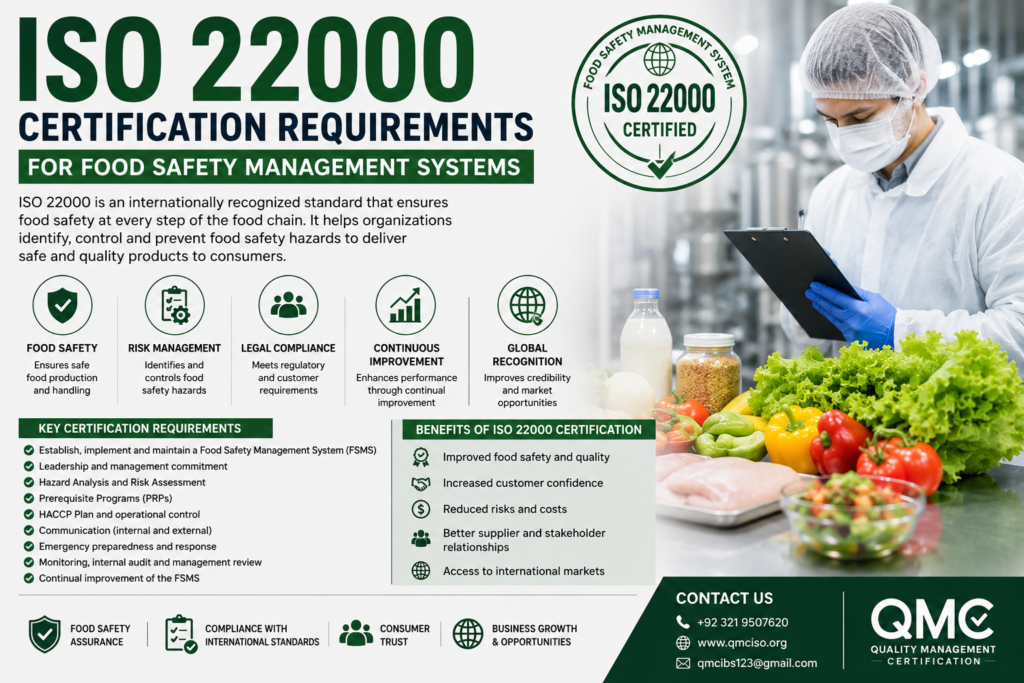
What is ISO 22000 Certification?
ISO 22000 is an international Food Safety Management System (FSMS) standard developed to help organizations ensure food safety throughout the supply chain.
The standard integrates:
- Hazard Analysis and Critical Control Points (HACCP)
- Risk-Based Thinking
- Food Safety Controls
- Continuous Improvement
- Regulatory Compliance
As a result, organizations can effectively manage food safety risks and enhance customer confidence.
Why is ISO 22000 Certification Important?
Implementing ISO 22000 helps businesses maintain high food safety standards.
Key Benefits
- Improved Food Safety Performance
- Enhanced Consumer Confidence
- Compliance with Regulatory Requirements
- Better Risk Management
- Increased Market Opportunities
- Improved Operational Efficiency
- International Recognition
Furthermore, many retailers, distributors, and international buyers prefer suppliers with ISO 22000 certification.
ISO 22000 Certification Requirements
Organizations seeking certification must meet several key requirements.
1. Food Safety Management System (FSMS)
The organization must establish, implement, maintain, and continually improve an effective Food Safety Management System.
2. Leadership Commitment
Top management must demonstrate leadership by establishing food safety policies, objectives, and responsibilities.
3. Hazard Analysis and Risk Assessment
Businesses must identify potential food safety hazards and evaluate associated risks throughout the production process.
4. Prerequisite Programs (PRPs)
Organizations must implement hygiene and operational controls, including:
- Cleaning and Sanitation
- Pest Control
- Waste Management
- Employee Hygiene
- Facility Maintenance
5. HACCP Plan
A documented HACCP plan must be developed to identify Critical Control Points (CCPs) and monitor food safety hazards.
6. Communication System
Effective communication must be maintained internally and externally regarding food safety matters.
7. Emergency Preparedness
The organization should establish procedures to respond to food safety incidents and emergencies.
8. Monitoring and Continuous Improvement
Regular audits, inspections, corrective actions, and management reviews are required to ensure ongoing compliance.
Documents Required for ISO 22000 Certification
The following documents are commonly required:
- Company Profile
- Food Safety Policy
- Scope of Certification
- HACCP Plan
- Risk Assessment Records
- Operational Procedures
- Employee Training Records
- Internal Audit Reports
- Management Review Records
- Corrective Action Reports
ISO 22000 Certification Process
Step 1: Gap Analysis
Evaluate current food safety practices against ISO 22000 requirements.
Step 2: Documentation Development
Prepare policies, procedures, manuals, and food safety records.
Step 3: System Implementation
Implement the Food Safety Management System across relevant operations.
Step 4: Internal Audit
Conduct internal audits to identify nonconformities and improvement opportunities.
Step 5: Certification Audit
An accredited certification body performs the external audit.
Step 6: Certification Approval
Upon successful completion of the audit, ISO 22000 certification is issued.
How QMC Can Help with ISO 22000 Certification?
Quality Management Certification (QMC) provides complete consultancy services, including:
- Gap Analysis
- Documentation Support
- HACCP Development
- Staff Training
- Internal Audit Assistance
- Certification Audit Preparation
Our experts help businesses achieve certification efficiently and effectively.
Related Services
- ISO 9001 Certification in Pakistan
- HACCP Certification Services
- Halal Certification Services
Conclusion
ISO 22000 certification is essential for organizations involved in food production, processing, packaging, storage, transportation, and distribution. It helps businesses improve food safety, comply with regulations, and gain customer trust.
Furthermore, achieving certification demonstrates a commitment to international food safety standards and continuous improvement. With professional guidance from QMC, your organization can successfully implement ISO 22000 and strengthen its position in the market.
Contact QMC Today
Need assistance with ISO 22000 Certification?
📞 +92 321 9507620
Call-to-Action
Contact QMC today for expert ISO 22000 certification consultancy and ensure compliance with internationally recognized food safety standards.